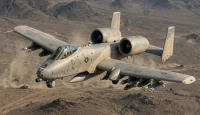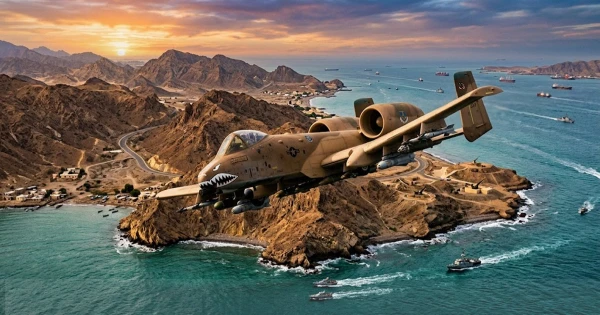
The geopolitical landscape of the Middle East has shifted dramatically, forcing military strategists to reconsider weapons once deemed obsolete. Air Force planners have spent years attempting to retire the Cold War-era A-10 Thunderbolt II, arguing that its slow speed and lack of stealth make it vulnerable to modern air defense systems. Yet, a startling development has captured global attention: Why the Pentagon Had to Sent the A-10 Warthog to IRAN?
As hostilities escalated under Operation Epic Fury, senior defense officials realized that high-tech, multi-million-dollar stealth fighters were not always optimal for the unique tactical realities of the Iranian theater. The legendary "Warthog," celebrated for its brutal efficiency in close air support, was pulled back from the brink of retirement to fulfill an indispensable role. This deep dive uncovers the tactical, financial, and strategic necessities that drove the Pentagon's surprising decision to deploy this armored beast.
The Strategic Shift of Operation Epic Fury
The operational environment of the Persian Gulf and coastal Iran presents an incredibly dense, highly asymmetric threat profile. While high-altitude stealth platforms like the F-35 Lightning II excel at breaking deep into enemy territory to neutralize advanced radar installations, they are vastly over-engineered and structurally fragile for low-altitude, sustained engagement.

Operation Epic Fury quickly evolved into an intense campaign involving fast-attack maritime craft, hidden shoreline missile batteries, and swarms of low-cost loitering munitions. To counter these dispersed threats, the U.S. military required a durable asset capable of staying over the battlefield for hours, identifying visually camouflaged targets, and absorbing heavy ground fire.
Countering Asymmetric Naval and Coastal Threats
Iran’s military doctrine relies heavily on swarm tactics using fast-attack craft in the narrow, congested waters of the Strait of Hormuz. For an advanced supersonic jet, targeting dozens of tiny, maneuvering boats moving at 40 knots is a massive logistical nightmare.
-
Loiter Time: The A-10 can hover over conflict zones for extended periods, providing constant surveillance and immediate striking power.
-
Low-Altitude Agility: Flying low and slow allows pilots to visually confirm targets, minimizing errors in chaotic maritime environments.
-
The GAU-8 Avenger: The Warthog’s iconic 30mm rotary cannon can shred light fast-attack craft and armored personnel carriers in seconds without consuming high-value precision missiles.
The Boneyard Reprieve: Why Tech Alone Failed
For over a decade, the Pentagon pushed to phase out the Warthog to allocate budget resources toward electronic warfare and fifth-generation stealth fighters. However, real-world friction in Operation Epic Fury proved that cutting-edge technology cannot entirely replace raw, armored firepower.
The A-10 was built specifically to survive intense anti-aircraft artillery. It features a redundant hydraulic system backed by manual mechanical controls, heavy titanium armor protecting the pilot, and engines spaced wide apart to survive catastrophic surface-to-air missile impacts. When operating within range of Iranian mobile air defense networks along the rugged coastline, the Warthog provided a level of survival assurance that delicate, radar-evading jets simply could not match.
Maximizing AdSense Potential: Financial Efficiency in Modern Warfare
From a defense economics perspective, deploying the A-10 Warthog is a masterstroke in high-ROI resource allocation. Modern military logistics are heavily constrained by flight-hour costs and maintenance turnarounds, making asset efficiency a critical metric for global stability.
-
Cost Per Flight Hour: Flying an A-10 costs approximately $6,000 to $7,000, whereas an F-35 surges past $35,000 to $42,000 per hour.
-
Ordnance Economy: Neutralizing dozens of decentralized coastal targets with precision-guided cruise missiles costs millions of dollars per sortie, rapidly depleting Western stockpiles.
-
Expeditionary Logistics: The A-10 can operate from unpaved, primitive airfields close to the front lines, reducing transit times and dependency on massive, vulnerable airbases.
Psychological Warfare and Regional Deterrence
Beyond its physical capabilities, the deployment of the Warthog serves as a potent tool for psychological deterrence. The distinct, low-frequency roar of its twin turbofan engines and the terrifying sound of its 30mm cannon are universally recognized across modern conflict zones.
By positioning these rugged attack aircraft near Iranian operational zones, the Pentagon delivered a clear, unambiguous message to regional actors and proxy forces. The presence of the Warthog signals a readiness for sustained, grinding close-quarters combat rather than just remote, high-altitude bombardment.
The Verdict on the Warthog's Undeniable Legacy
Ultimately, understanding Why the Pentagon Had to Sent the A-10 Warthog to IRAN? requires looking past the glamour of stealth technology and focusing on the grim realities of asymmetric warfare. The A-10 Thunderbolt II continues to prove that a heavily armored frame, massive ammunition capacity, and low operational costs are irreplaceable assets in complex regional conflicts. Rather than fading away into the boneyard, this legendary aircraft remains a vital pillar of American power projection.
What are your thoughts on the Pentagon's decision to utilize the A-10 Warthog in modern operations? Do you think stealth jets should completely replace these older, armored platforms? Let us know your perspective in the comments below, and don't forget to share this article with fellow military tech enthusiasts!