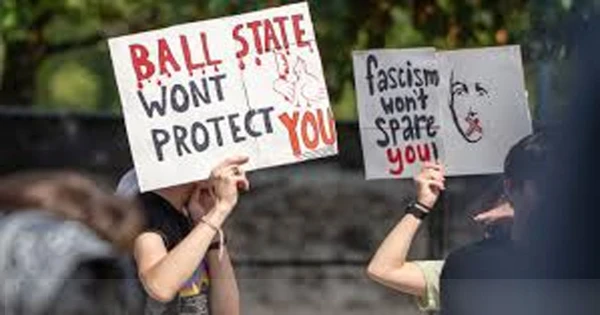
Ball State University has spent nearly three-quarters of a million dollars defending its decision to fire an employee over a controversial social media post about conservative activist Charlie Kirk, a cost that has sparked debate about free speech protections on public college campuses.
The university paid approximately $500,000 in outside legal fees before agreeing to a $225,000 settlement with former health director Suzanne Swierc, who was terminated in September after posting comments about Kirk on her private Facebook page . The total expenditure is equivalent to the in-state tuition cost for roughly 80 students, raising questions about resource allocation amid ongoing budget pressures.
Swierc, who served as director of health promotion and advocacy, filed a federal lawsuit against Ball State President Geoffrey Mearns with support from the American Civil Liberties Union of Indiana. The suit alleged her firing violated her First Amendment rights because she had spoken as a private citizen on a matter of public concern .
President Mearns defended the decision to terminate Swierc, arguing that the post caused significant disruption to university operations. In an email to university leadership, he stated that the backlash, including threats and calls to withhold donations, was "extraordinarily damaging to our University's reputation and image" . The university admitted no wrongdoing as part of the settlement agreement .
The case has become a flashpoint in a broader national debate about workplace speech and political expression. Swierc was among a wave of employees across the country who faced termination or disciplinary action following their comments about Kirk, who was assassinated on a Utah university campus in September .
The ACLU argued that the First Amendment clearly protects Swierc's speech. "The First Amendment does not allow government institutions to retaliate in those circumstances, and this settlement reflects that," said Stevie Pactor, senior staff attorney for the ACLU of Indiana .
Legal Fees Mount With High-Priced Firms
Throughout the eight-month lawsuit, Ball State employed four different outside law firms, including two based outside Indiana. Public records obtained through open records requests revealed a detailed breakdown of the university's legal spending .
Washington, D.C.-based Jones Day handled the bulk of the litigation, invoicing the university approximately $311,000. The global firm, which has represented President Donald Trump in other matters, did not disclose its attorneys' hourly rates in returned records .
Cleveland-based BakerHostetler was also retained for legal advice and charged $12,000, with one attorney billing at $1,160 per hour, according to the firm's engagement letter. Two prominent Indiana firms, Taft Stettinius & Hollister LLP and Ice Miller LLP, also worked on the case through existing agreements with the university .
Taft invoiced Ball State for $154,000 over six months, with attorneys charging between $215 and $875 per hour. Ice Miller billed $10,000, with rates ranging from $675 to $975 per hour .
These figures do not include the university's internal legal costs. General Counsel Sali Falling earned $273,000 in 2025, and her office's other seven employees collectively made about $884,000 .
Public University Faces First Amendment Questions
As a public institution, Ball State is bound by constitutional protections that do not apply to private employers. A 1968 U.S. Supreme Court ruling established that public employees do not forfeit their First Amendment rights when speaking on matters of public importance in their private capacity .
However, courts have recognized limits when employee speech substantially disrupts workplace operations. Mearns maintained that the disruption caused by Swierc's post justified the termination, noting that staff members fielded threatening calls and felt unsafe on campus .
The university's decision drew both praise and criticism. Indiana Attorney General Todd Rokita commended the firing, while free speech advocates and some members of the university community questioned whether the action violated constitutional protections .
Mearns acknowledged these concerns in his May email, writing: "Some faculty, staff, students, and other people associated with our University have questioned whether my decision to terminate Ms. Swierc's employment violated her First Amendment rights" .
Broader Implications for Public Universities
The case emerges as Indiana's public universities face budget constraints following reduced state legislative funding, leading to program cuts and cost-saving measures across the system . The settlement amount adds to these financial pressures, with taxpayer dollars and student tuition contributing to the cost.
Swierc's case is not isolated. Similar lawsuits have been filed against other public institutions, including Auburn University in Alabama, where employees were terminated for social media posts about Kirk. In Florida, a state agency recently agreed to pay $485,000 to settle a lawsuit from a biologist fired over a Kirk-related meme .
As public universities navigate the complex intersection of employee speech rights and institutional stability, the Ball State case offers a cautionary example of the financial and legal risks involved in disciplining staff for political expression.
Swierc, now 37, continues to struggle with the personal toll of the ordeal. She told The New York Times in an interview that she still experiences depression, anxiety, and panic attacks, and has not found full-time employment since her termination, working part-time at a local nonprofit in Muncie .