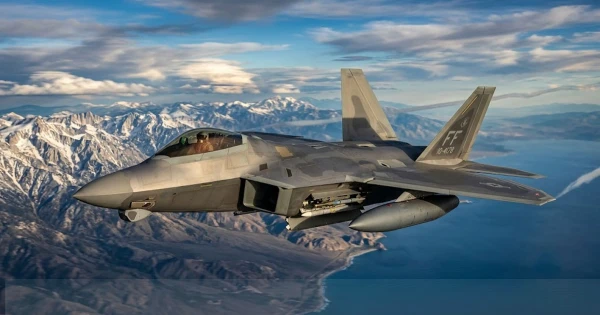
The F-22 Raptor modernization effort is shaping up as one of the most important airpower stories in the Pentagon’s inventory, because it is about more than keeping an old fighter flying. It is about giving a small but elite fleet the range, sensors, and software it needs to stay relevant against modern threats while the next generation of American air dominance takes shape.
Why modernization matters
The F-22 has always been a specialized aircraft: built for air superiority, designed to see first, shoot first, and survive in contested airspace. But its age, limited numbers, and the demands of long-distance operations have made modernization a practical necessity rather than a luxury.
The U.S. Air Force has also had to think carefully about the gap between the Raptor it already owns and the fighter it ultimately expects to replace it. That makes the F-22 modernization program a bridge strategy as much as a capability upgrade.
Inside the F-35 Lightning II: What Every American Should Know About the Jet Reshaping U.S. Air Power

What is being upgraded
Several strands of work are associated with the F-22 Raptor modernization effort. The most visible are stealth-optimized external fuel tanks and underwing infrared search-and-track, or IRST, pods, both intended to improve range and detection without fully sacrificing the aircraft’s low-observable advantages.19fortyfive
Lockheed Martin has also described broader “viability” upgrades that include improvements to stealth features, radar, electronic warfare, and the aircraft’s low-observable performance. In addition, the company says the more modern Block 30/35 fleet is moving into a software-defined open mission systems architecture, which makes it easier to add new capabilities over time.
Range and sensors
Range has long been one of the Raptor’s most discussed limitations, especially for operations in the Indo-Pacific, where distance shapes every mission plan. The new low-drag external tanks are meant to ease that constraint by extending reach while reducing some of the radar penalty associated with older tank designs.19fortyfive
The IRST pods matter for a different reason: they let the F-22 detect and track aircraft passively, meaning it can gather targeting information without broadcasting radar energy that could expose its position. That kind of sensor package fits the modern air combat environment, where electronic warfare and stealth counters have become increasingly important.19fortyfive
Block 20 dilemma
A major question in F-22 Raptor modernization involves the older Block 20 aircraft, which the Air Force still uses for training. Lockheed Martin has said it is discussing whether these jets could also be brought into the upgrade effort, expanding the pool of aircraft that could benefit from modernization.
That matters because the Air Force currently has 185 F-22s, but only 143 are combat-coded, with the remainder used for training and test roles. Even without upgrades, Air Force leaders have argued that the Block 20 jets still provide significant training value and could be useful in a crisis.
Software and mission systems
Modern fighters depend as much on software as on aerodynamics, and the F-22 is no exception. The move toward an open mission systems architecture is especially important because it gives the aircraft a better path for integrating sensors, weapons, and electronic warfare tools over time.
That approach helps the Raptor avoid becoming technologically frozen. Instead of requiring a full redesign every time new hardware arrives, the aircraft can absorb more of the next generation’s capabilities in smaller, more manageable steps.
Stealth still counts
Even as the Air Force pushes to improve range and sensing, it is trying not to erode the F-22’s defining advantage: stealth. That is why the newer fuel tanks and sensor pods are being shaped and positioned to minimize penalties as much as possible.united24media+1
This balance is central to the modernization effort. A fighter that can travel farther but becomes too visible would lose much of its value in high-end combat, so the upgrades are being designed to preserve the Raptor’s survivability while improving its reach and awareness.
Bridge to the future
The F-22 Raptor modernization program also reflects the uncertainty around the Air Force’s next fighter. The Raptor is serving as a bridge to the Boeing F-47, the aircraft tied to the Next Generation Air Dominance effort.
That means the Air Force is not just trying to stretch the F-22’s life span. It is also using the jet as a pathfinder for future technologies, including crewed-uncrewed teaming and next-generation sensors. In that sense, the Raptor remains both a frontline weapon and a testbed for what comes next.
What readers should watch
For defense watchers, the biggest takeaways are straightforward:
-
The F-22 is not being left behind; it is being adapted for a more difficult air combat environment.
-
Range, passive sensing, and software flexibility are the modernization priorities most likely to shape the aircraft’s future.19fortyfive
-
The fate of the older Block 20 jets will help determine how many Raptors can benefit from the broader upgrade effort.
-
The modernization push is closely tied to the Air Force’s long-term transition to the F-47 and other future systems.
Conclusion
The F-22 Raptor modernization effort shows how the Air Force is trying to preserve a high-value capability in a world that has moved beyond the assumptions of the early 2000s. By improving range, sensors, stealth resilience, and software flexibility, the service is working to keep the Raptor useful well into the future without pretending it is a brand-new aircraft.
For the public, the larger lesson is simple: modernization is how advanced military aircraft stay relevant. For the F-22, that means evolving carefully, preserving what makes the jet exceptional, and preparing it to fight in a more complex battlespace.