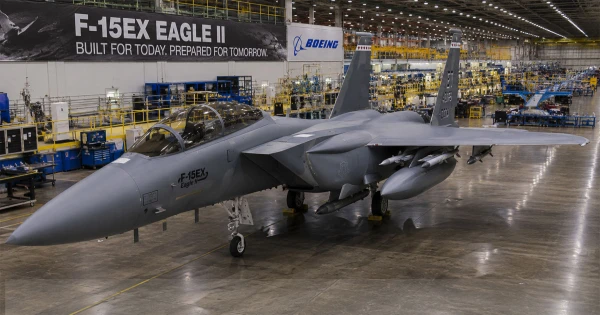
The most modern fighter jet rolling off an American assembly line today isn't a stealthy, radar-evading design hidden under a black-program shroud. It's a direct descendant of an aircraft that first flew during the Ford administration. The F-15EX Eagle II looks, at a glance, like the F-15s that have patrolled American skies since the 1970s. Underneath that familiar silhouette sits one of the most heavily armed, electronically sophisticated fighters ever built — and the U.S. Air Force is counting on it to carry a disproportionate share of the nation's airpower for decades to come.
That combination of old-school airframe and new-generation brains is why the F-15EX has become one of the more closely watched procurement stories in American defense circles. It isn't trying to replace the stealthy F-22 Raptor or F-35 Lightning II. Instead, it fills a gap those aircraft can't fill alone: hauling enormous quantities of weapons, cheaply and reliably, while the stealth fleet handles missions that demand to go unseen.
What the F-15EX Eagle II Actually Is
The F-15EX is a twin-engine, multirole fighter built by Boeing in St. Louis, Missouri. It traces its lineage to the F-15E Strike Eagle, in service since the late 1980s, and more directly to the "Advanced Eagle" export variants developed for Saudi Arabia and Qatar. Those export models proved out a new digital fly-by-wire flight control system, a stronger airframe, and a glass cockpit years before the Pentagon decided to buy a version for itself.

That history matters for one practical reason: the Eagle II didn't require years of brand-new design work. The Air Force essentially adopted a proven, already-flying platform and adapted it for domestic service, keeping costs and schedule risk lower than a clean-sheet fighter program would have.
Key identifying features of the F-15EX include:
- A two-seat configuration as standard, with a pilot up front and a second crew member who can manage sensors, weapons, and increasingly, unmanned "loyal wingman" drones flying alongside the jet.
- A digital fly-by-wire flight control system, replacing the older mechanical-hydraulic controls found on legacy F-15C/D models.
- Large, glass cockpit displays instead of the analog gauges of older Eagles.
- An open-architecture mission computer, designed so new software, sensors, and weapons can be added without a full hardware overhaul.
Why the Air Force Wanted This Jet in the First Place
To understand why the Pentagon committed billions of dollars to a fighter built on 1970s aerodynamics, it helps to look at what it's replacing. The Air Force's F-15C/D fleet — the pure air-superiority Eagles that have guarded American and allied skies since the Cold War — had simply run out of structural life. Decades of high-stress flying wore down those airframes faster than expected, and the F-22 Raptor program meant to replace them was cut short in the early 2010s at a fraction of its planned size.
That left a hole in the fighter inventory. The Air Force needed a way to replace tired airframes quickly, without waiting a decade for a new design to mature, and without diverting limited F-35 and F-22 production toward a mission those jets weren't optimized for. The F-15EX offered a practical answer.
The Case for a "Non-Stealthy" Fighter in a Stealth Era
It might seem counterintuitive for the Air Force to invest heavily in a fighter without stealth shaping when adversaries are fielding increasingly capable air defenses. The reasoning reflects a division of labor that has become a recurring theme in modern airpower planning:
- Stealth aircraft are scarce and expensive. The F-22 is no longer in production, and F-35s are in high demand across every branch of the military and dozens of allied air forces.
- Not every mission requires stealth. Homeland air defense, training, and many strike missions in less contested airspace don't need a low-observable jet, and using an F-22 or F-35 for them wastes a scarce asset.
- Mass still matters. A fighter that carries far more missiles and bombs than a stealth jet, more cheaply per flight hour, adds real capacity even without a low radar signature.
- Survivability isn't only about stealth. The F-15EX relies on a powerful electronic warfare suite, advanced radar, and speed and maneuverability to survive in contested airspace.
In short, the Eagle II isn't meant to sneak past enemy radar. It's meant to stand off at range and launch a large volume of precision weapons, letting stealth aircraft handle missions that require getting in close undetected.
Payload, Range, and Speed: The Eagle II's Defining Strengths
Ask anyone familiar with the program what sets the F-15EX apart, and the conversation almost always returns to payload. The aircraft is built around the idea that a large volume of ordnance, delivered reliably and affordably, is itself a form of combat power.
The Eagle II's air-to-air weapons stations were expanded specifically to maximize this advantage. Where older Eagle variants could carry up to eight air-to-air missiles, the EX's additional wingtip-area stations let it carry significantly more, giving a single aircraft a larger missile salvo before needing to return and reload. In a strike configuration, it can carry a wide mix of precision-guided bombs, small-diameter munitions, and long-range cruise missiles.
Other performance characteristics that matter for long-term context:
- Speed: roughly Mach 2.5, among the fastest operational fighters in the world.
- Range: with conformal fuel tanks and aerial refueling, it can cover thousands of miles without landing.
- Service life: the airframe was engineered for substantially longer structural life than the F-15C/D models it replaces, addressing the fatigue problems that pushed the program forward.
- Engines: twin afterburning turbofans give the aircraft a high thrust-to-weight ratio for rapid intercepts and sustained high-speed cruise.
How the F-15EX Fits Into the Broader Air Force Fleet
One of the more persistent misconceptions about the F-15EX is that it's meant to compete with, or replace, the F-35. In practice, the Air Force has been explicit that the two aircraft complement one another rather than substitute for each other.
The F-35 is built around low observability, sensor fusion, and the ability to operate inside contested airspace where being detected carries severe risk. The F-15EX is built around weapons capacity, speed, and lower cost per flying hour. Air Force planners describe the EX as a way to preserve the size of the overall fighter fleet — sometimes called "fleet mass" — without spending fifth-generation dollars on missions that don't require fifth-generation capability.
This division of roles shows up in how the aircraft has been assigned. Rather than sending Eagle IIs to frontline combat wings exclusively, the service has prioritized Air National Guard units handling homeland defense and air sovereignty, along with select active-duty wings at strategically important overseas locations.
Common Questions About the F-15EX Eagle II
Is the F-15EX a stealth fighter? No. It does not use the radar-evading shaping or coatings found on the F-22 or F-35. It relies instead on electronic warfare systems, speed, and weapons capacity for survivability.
Why did the Air Force buy a new version of an old design instead of a new aircraft entirely? Building on an already-proven airframe and avionics suite, developed through export versions sold to allied nations, let the Air Force field a modern fighter faster and at lower technical risk than starting from scratch.
Does the F-15EX use the same parts as older F-15s? Yes, to a significant degree. Substantial parts commonality with earlier F-15C and F-15E models simplifies maintenance, training, and logistics, since existing supply systems don't need to be rebuilt.
What missions is the F-15EX best suited for? Homeland air defense, long-range strike missions carrying large numbers of precision weapons, and supplementing stealth aircraft by absorbing munitions-heavy roles that don't require a low radar signature.
The Bigger Picture: Why This Program Endures
The F-15EX Eagle II illustrates a recurring principle in military aviation: cutting-edge capability doesn't always require an entirely new airframe. By pairing a structurally reinforced, combat-proven design with modern digital flight controls, sensors, and an open-systems architecture built for future upgrades, the Air Force gained a fighter that's relevant today and adaptable for years to come, without the cost and schedule risk of starting from a blank sheet of paper.
That adaptability is the program's real long-term value. As threats evolve and new sensors, weapons, and networking technologies mature, the Eagle II's open architecture is designed to absorb upgrades incrementally rather than requiring an entirely new aircraft program down the road. Combined with its high weapons capacity and lower operating costs relative to stealth aircraft, that flexibility is why the F-15EX has secured a lasting role in the U.S. fighter fleet — not as a replacement for fifth-generation stealth, but as the dependable, heavily armed partner that lets those aircraft do what they do best. The throughline is straightforward: the F-15EX Eagle II is a deliberate, cost-conscious bet that proven aerodynamics, modern avionics, and sheer weapons capacity still have a defining role to play in how the United States projects and defends airpower for years to come.