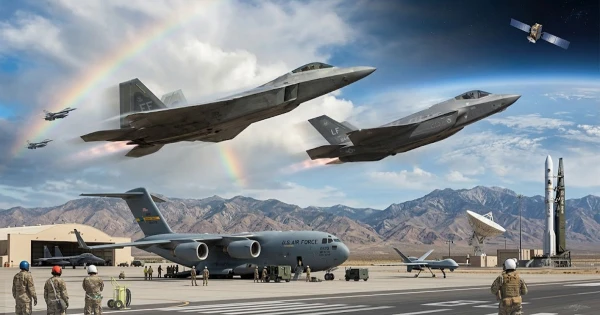
The United States Air Force stands as one of the most formidable and technologically advanced military organizations in the world, dedicated to securing American interests through dominance in the air, space, and cyberspace domains. From its roots in early aviation experiments to its current role as a cornerstone of national defense, the Air Force delivers unmatched capabilities in global reach, precision strike, intelligence gathering, and rapid response. In an era of evolving threats, its commitment to air superiority, innovation, and the professional development of Airmen ensures it remains ready to fly, fight, and win—anytime, anywhere.
This comprehensive look at the United States Air Force explores its rich history, core missions, organizational structure, people, technology, and lasting contributions to national security—timeless elements that define its strength and relevance for generations.
A Century of Aviation Excellence: The Evolution of the United States Air Force
The story of the United States Air Force begins long before its formal establishment as an independent branch. Its origins trace back to August 1, 1907, when the U.S. Army Signal Corps created an Aeronautical Division to explore military uses of balloons and early aircraft. World War I accelerated development, with American pilots flying alongside allies in rudimentary planes, honing tactics that would shape future air power.

Between the world wars, the Army Air Corps expanded training and procurement. World War II showcased the decisive impact of air power through massive bombing campaigns, long-range fighter escorts, and strategic mobility that supported Allied victories across multiple theaters. The experience proved that control of the skies could determine the outcome of conflicts.
The National Security Act of 1947 marked a pivotal moment, separating the air arm from the Army and creating the independent United States Air Force on September 18, 1947. This reorganization recognized air power's unique strategic role in modern warfare. Over the decades, the Air Force adapted through the Cold War, conflicts in Korea and Vietnam, Operations Desert Storm and Iraqi Freedom, and ongoing global operations, consistently evolving its doctrine, equipment, and personnel to meet new challenges.
Today, the United States Air Force operates as the world's largest and most capable air force, maintaining a legacy of innovation while upholding core values of integrity first, service before self, and excellence in all we do.
Core Missions: What the United States Air Force Does
The United States Air Force defines its responsibilities through five enduring core missions that guide operations across all domains:
- Air Superiority: Achieving and maintaining control of the air to prevent adversaries from interfering with friendly forces while enabling freedom of action.
- Global Integrated Intelligence, Surveillance, and Reconnaissance (ISR): Providing timely, accurate information through advanced sensors, platforms, and analysis to support decision-making at all levels.
- Rapid Global Mobility: Delivering personnel, equipment, and supplies anywhere in the world quickly and reliably via airlift and refueling assets.
- Global Strike: Projecting precise, lethal power through bombers, fighters, and other systems to hold targets at risk across vast distances.
- Command and Control: Ensuring effective leadership, communication, and coordination of forces in dynamic environments.
These missions interconnect to support joint operations with the Army, Navy, Marine Corps, and Space Force, while also contributing to homeland defense, humanitarian efforts, and international partnerships. The Air Force's ability to operate seamlessly across domains makes it indispensable in both peacetime deterrence and wartime execution.
Organizational Structure: How the United States Air Force Operates
The United States Air Force employs a clear, hierarchical structure designed for efficiency and flexibility. At the top sits the Department of the Air Force, led by the Secretary of the Air Force (a civilian) and the Chief of Staff of the Air Force. This department oversees both the Air Force and the Space Force.
Major Commands (MAJCOMs) form the next level, each focusing on specific functions or regions. Key examples include:
- Air Combat Command: Oversees combat aircraft and operations in the continental United States.
- Air Mobility Command: Manages global airlift and refueling.
- Air Education and Training Command: Handles recruiting, basic training, technical education, and leadership development.
- Pacific Air Forces and U.S. Air Forces in Europe: Provide regionally focused capabilities.
Below MAJCOMs are Numbered Air Forces, Wings, Groups, Squadrons, and Flights. Wings often serve as the primary operational units, combining aircraft, maintenance, support, and personnel for specific missions. This structure allows the Air Force to scale operations effectively, whether deploying a fighter squadron or managing a large logistics hub.
The enlisted force is organized into tiers—Junior Enlisted, Noncommissioned Officers (NCOs), and Senior NCOs—each with increasing leadership responsibilities. Officers progress through ranks emphasizing command, technical expertise, and strategic thinking.
The People Behind the Power: Airmen and Their Training
The strength of the United States Air Force lies in its Airmen—highly skilled professionals dedicated to service. Enlisted personnel and officers undergo rigorous selection and training to prepare for demanding roles.
All enlisted recruits complete Basic Military Training (BMT) at Joint Base San Antonio-Lackland in Texas. This approximately 7.5-week program builds discipline, physical fitness, core values, and foundational military skills. Graduates then attend technical training schools to master their specific Air Force Specialty Codes (AFSCs), ranging from aircraft maintenance and cyber operations to intelligence and medical support.
Officer candidates pursue paths through the U.S. Air Force Academy, Officer Training School, or Reserve Officer Training Corps (ROTC) programs. Specialized training follows for pilots, navigators, and other roles, often involving advanced simulators and flight instruction.
The Air Force emphasizes continuous professional development. Leadership schools, advanced degrees through the Air Force Institute of Technology, and real-world assignments build expertise. Diversity in backgrounds and skills strengthens the force, fostering innovation and adaptability.
Families and civilian employees also play vital supporting roles, contributing to base operations, research, and community resilience.
Technology and Innovation: Staying Ahead in the United States Air Force
Technological superiority remains central to the United States Air Force's effectiveness. The service operates a vast fleet including fighters like the F-35 Lightning II and F-22 Raptor, strategic bombers such as the B-52 Stratofortress and B-2 Spirit, tankers, transport aircraft, and unmanned systems. It also manages intercontinental ballistic missiles as part of the nation's nuclear deterrent.
The Air Force Research Laboratory drives advancements in areas like directed energy, hypersonics, artificial intelligence, and cybersecurity. Partnerships with industry, academia, and other services accelerate the integration of emerging technologies while maintaining rigorous testing standards.
Innovation extends beyond hardware. The Air Force invests in data analytics, resilient communications, and training systems that prepare Airmen for contested environments. This focus on long-term technological edge ensures the service can deter aggression and prevail if called upon.
Roles in National Defense and Global Stability
The United States Air Force contributes to deterrence by maintaining a credible, ready force that adversaries must respect. Its global presence through forward-deployed units and rapid mobility supports alliances and reassures partners.
In humanitarian missions, Air Force aircraft deliver disaster relief, evacuate personnel, and provide medical support worldwide. Search and rescue capabilities save lives in peacetime and combat.
The service addresses modern challenges such as great-power competition, regional instability, and hybrid threats through integrated operations that combine kinetic and non-kinetic effects. Emphasis on agility, survivability, and multi-domain integration prepares it for future conflicts.
Common Questions and Misconceptions About the United States Air Force
Many wonder about daily life in the Air Force. Airmen balance mission demands with professional growth, family time, and community involvement. Bases offer comprehensive support services, education opportunities, and quality-of-life programs.
Another frequent question concerns career paths. The Air Force offers diverse opportunities in aviation, engineering, intelligence, logistics, cyber, healthcare, and administration—many with strong civilian transferability.
Misconceptions include the idea that the Air Force is purely about flying. While pilots are essential, the majority of roles support the mission through maintenance, security, analysis, and sustainment. Teamwork across specialties defines success.
Eligibility requirements focus on age, physical fitness, education, and moral character, with opportunities for both active duty and reserve components.
Challenges and Best Practices for Success in the United States Air Force
Operating high-performance aircraft and complex systems demands meticulous maintenance, safety protocols, and attention to detail. The Air Force addresses human factors like fatigue and stress through evidence-based programs and leadership emphasis on well-being.
Recruitment and retention remain priorities. Strategies include competitive benefits, career progression, and recognition of service. Airmen are encouraged to pursue education, mentorship, and cross-training to build resilience.
For those considering service, preparation involves physical conditioning, academic readiness, and understanding the commitment to core values. Veterans and retirees continue contributing through mentorship and community leadership.
The Timeless Legacy of the United States Air Force
The United States Air Force embodies American ingenuity, courage, and resolve. Its history of adaptation, clear mission focus, structured organization, skilled personnel, and relentless innovation ensure its continued vital role in protecting the nation and promoting global stability.
Whether safeguarding the homeland, supporting allies, or advancing technology, the men and women of the Air Force deliver results that matter. Their service reminds us of the importance of air power in an interconnected world and the enduring principles that sustain a strong defense.
For those inspired by this legacy, exploring opportunities to serve, supporting military families, or simply learning more about aviation history offers meaningful ways to engage. The United States Air Force's story is one of excellence and dedication—a model of what disciplined, forward-thinking professionals can achieve.