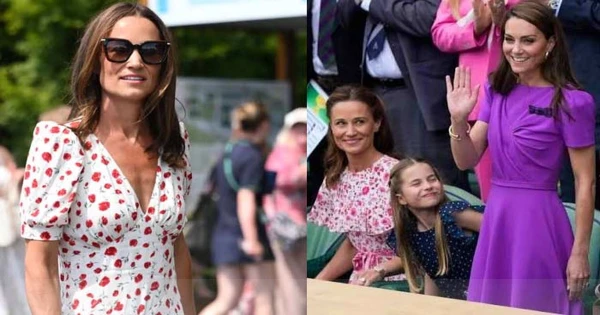
Pippa Middleton and her husband, financier James Matthews, have won an appeal blocking the public from using a driveway that cuts through their Berkshire country estate, after a government-appointed planning inspector ruled that local walkers did not prove the route had been used continuously for the 20 years required to establish a public right of way. The decision, issued Monday, overturns an earlier designation that would have allowed public access, according to reports.
The dispute centered on Barton Court, a large Georgian property and surrounding land near the village of Kintbury. Matthews bought the estate for £15.5 million in 2022, and it sits about 12 miles from the Berkshire childhood home of Pippa, 43, and her sister Catherine, the Princess of Wales.
Villagers had argued that the driveway had been used for generations as a convenient link to a public footpath leading toward local destinations including the village’s 12th-century church. Backed by the Ramblers’ Association, more than 30 walkers petitioned West Berkshire District Council to formally recognize the route as a public right of way—an application that was granted in 2024.
Matthews, 51, challenged that decision. At a public inquiry held in May, he argued the driveway had not been used freely and openly by the public for the legally required two decades. Matthews also told the inquiry that when he purchased the property, nothing in the conveyancing process indicated any public entitlement to use the drive.
The inspector ultimately sided with the landowners, finding the walkers had not provided enough evidence of qualifying use over the necessary 20-year period. The ruling reversed the earlier council designation, giving the couple control over access to the driveway.
The inquiry heard that within weeks of the couple taking possession of Barton Court, electric gates were installed across the driveway, along with signs stating “No Trespassing” and “Private: No Public Access,” according to reports.
Matthews defended the need for gates by pointing to heightened security considerations connected to the family’s public profile. “There are implications for my family, due to their high public profile, which means there is a need for a higher level of security than would otherwise be the case,” he told the inquiry, according to the reports.
Support for the couple also came from Lady Victoria Conran, the widow of designer Sir Terence Conran, who sold Barton Court—described as a 32-room mansion set on 145 acres—to Matthews and Middleton after her husband’s death. In a statement to the inquiry, she said that during the roughly 30 years she lived at Barton Court, she saw only one person using the driveway who “should not have been there,” adding she never observed organized groups of walkers using it.
Not everyone welcomed the outcome. Local councillor Tony Vickers said he was “surprised and very disappointed” the inspector found for the landowner, adding that after attending most of the inquiry he did not believe Matthews’ side had offered a decisive argument, according to reports.
A spokesperson for Matthews and Middleton responded by saying the couple was grateful for the careful review of the evidence and appreciated the time invested by all parties.
Why this matters
Public rights of way are a defining feature of the U.K.’s countryside access system, and disputes often hinge on whether a route meets the strict legal tests—especially the 20-year “as of right” use threshold that can effectively create a presumed public right. As high-value rural estates change hands and more landowners install gates and security measures, conflicts between privacy, security, and community access have become more visible. The ruling also underscores that local authorities’ decisions on footpaths can be overturned when evidence does not meet the legal standard.
For now, the inspector’s decision gives Middleton and Matthews a significant privacy victory and limits public passage through Barton Court.