


NBS বাংলা | ২৪/৭ সর্বশেষ সংবাদ ও আপডেট | অন্যান্য খবর — 18 November 2026, 5:41 PM
World’s Values-Based Banks Call for Broader Approach to Financial Inclusion
BRAC Bank joins GABV’s Banking on Values Day 2026 campaign to spotlight barriers to financial inclusion
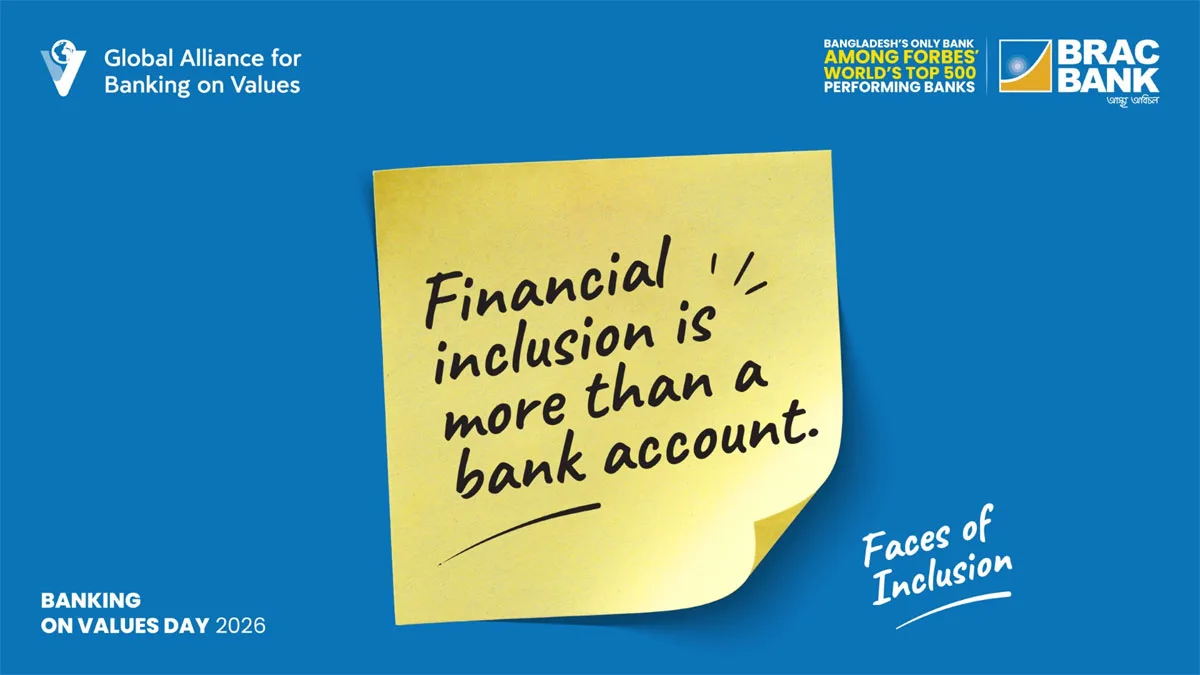
Having a bank account does not necessarily mean financial inclusion. Even when financial services are available, people may struggle to use them because of high costs, complicated procedures, unsuitable products or services that do not meet their needs.
This is the central message of Faces of Inclusion, the theme of Banking on Values Day 2026, an annual global campaign organised by the Global Alliance for Banking on Values (GABV).
BRAC Bank, the only Bangladeshi bank in the alliance and a founding member since 2009, has joined the campaign alongside values-based banks worldwide. This year's campaign highlights the different barriers to financial inclusion and practical ways to make financial services more accessible and useful to individuals, businesses and communities.
BRAC Bank was established to address the financing needs of the unbanked and underbanked 'missing middle', particularly small and medium-sized entrepreneurs who often struggle to access formal financial services.
Over the past 25 years, the bank has financed more than 20 lakh small and medium entrepreneurs, disbursing approximately BDT 2 lakh crore in loans. Its financing has positively impacted the lives of an estimated two crore people across Bangladesh.
Tareq Refat Ullah Khan, Managing Director & CEO of BRAC Bank, said: “The GABV survey provides valuable international insights into the causes of financial exclusion, many of which are relevant to Bangladesh. These include affordability, documentation requirements, collateral constraints and financial services that do not adequately meet customers' needs.”
“The findings will help us better understand these barriers, examine them in the context of our local market and identify practical solutions. We believe these insights can help BRAC Bank and other financial institutions make financial services more accessible, relevant and responsive to underserved individuals and businesses.”
Financial exclusion goes beyond access
To understand the different dimensions of financial exclusion, GABV surveyed its 74 member institutions across 48 countries. Responses covered 89% of its membership, offering insights from financial institutions working directly with underserved communities.
The findings show that access to financial services alone does not guarantee inclusion.
While 36% of respondents identified lack of access as the main cause of financial exclusion, nearly two-thirds pointed to barriers that remain even when services are available.
Among respondents, 42% said financial services are not adequately tailored to people's needs, 14% identified a lack of trust or use, and 8% cited high costs.
The survey also identified several barriers within the financial system. Collateral or eligibility requirements were cited by 62% of respondents, followed by documentation or legal identity requirements (38%) and the cost of financial services (29%).
Martin Rohner, Executive Director of the Global Alliance for Banking on Values, said:
“Financial inclusion should not be measured only by how many people enter the financial system, but by whether that system works for them once they are there. Financial services must be accessible, affordable and applicable to people’s real needs and circumstances. This Banking on Values Day, we are looking beyond the statistics to understand the different realities of financial inclusion and exclusion.”
Financial exclusion affects people and local economies
The survey also highlights the economic consequences of financial exclusion.
One-third of respondents identified increased economic vulnerability as a consequence. Others pointed to dependence on informal or predatory lending (18%), lack of access to affordable credit (14%) and limited participation in the formal economy and employment (12%).
Barriers to starting or expanding businesses and restrictions on local economic development were each cited by 11% of respondents.
The findings show that financial exclusion affects different groups across both emerging and developed markets, from customers of microfinance institutions to disadvantaged communities served by credit unions.
Respondents identified low-income individuals and households (53%) as the most affected, followed by migrants and refugees (45%), rural or remote communities (41%), women (29%) and micro, small and medium-sized enterprises (24%).
Relationship banking and tailored services can improve inclusion
The survey also explored which approaches are most effective in serving financially excluded communities.
Values-based banks identified relationship banking (52%), financial products tailored to customers' needs (50%) and financial literacy initiatives (41%) as the most effective approaches.
These findings reinforce the importance of looking beyond account ownership and expanding access to financial services that people can afford, understand and use.
Through its participation in Banking on Values Day 2026, BRAC Bank reaffirms its commitment to addressing financial exclusion and advancing values-based banking in Bangladesh.
A shared challenge - Participating GABV institutions also pointed to the role of the wider financial ecosystem. When asked for the single most important action governments or regulators should take, 41% selected aligning incentives or requirements for banks with financial-inclusion objectives, followed by support for financial-literacy initiatives at 26%. Stronger consumer-protection frameworks and improved digital infrastructure were each selected by 12%.
Read the article with the detailed survey results and explore the Faces of Inclusion campaign: www.bankingonvaluesday.com

Contributor, NBS বাংলা | ২৪/৭ সর্বশেষ সংবাদ ও আপডেট | অন্যান্য খবর