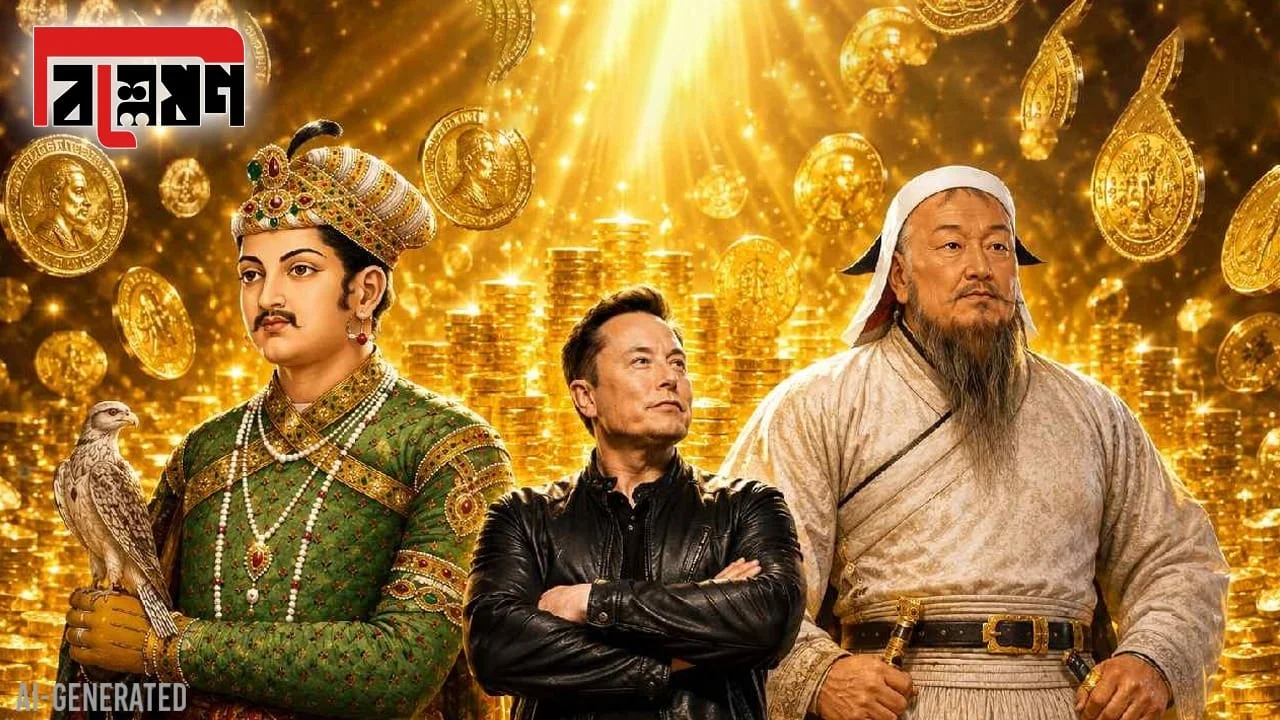
Elon Musk has made history by becoming the world's first trillionaire in modern currency terms. The Tesla and SpaceX CEO's net worth has surpassed the $1 trillion mark, placing him in an exclusive financial category. However, when adjusted for inflation and relative economic power, several historical figures possessed wealth far exceeding Musk's current fortune.
Historical records reveal that ancient rulers and emperors controlled vast fortunes that would dwarf today's billionaires in comparative value. These individuals commanded enormous resources through territorial conquest, taxation systems, and control over global trade routes. Their accumulated wealth, measured as a percentage of global GDP, far exceeds the financial standing of contemporary business magnates.
Augustus Caesar, who ruled the Roman Empire from 63 BC to 14 AD, controlled approximately thirty percent of the world's total economy during his reign. The first Roman emperor personally held about one-fifth of the empire's total wealth through vast landholdings and precious treasures. Adjusted to modern economic standards, his fortune would be valued at approximately $5 trillion in 2022 terms.

The Roman ruler transformed a war-torn republic into a superpower through strategic governance and military conquests. Caesar implemented tax reforms, expanded infrastructure, and established a stable administrative system throughout the Mediterranean region. His economic policies laid the foundation for the Roman Empire's centuries-long prosperity and territorial expansion.
Joseph Stalin, who led the Soviet Union from 1924 until his death in 1953, controlled a different form of immense wealth. Born in Georgia, Stalin rose to become the General Secretary of the Communist Party and consolidated absolute power over the USSR. His administration commanded approximately 9.5 percent of the world's total economic output during the peak of his rule.
In today's dollars, the Soviet economy's value under Stalin would amount to roughly $7.5 trillion. Stalin appointed loyal officials to key positions and established steel factories, manufacturing plants, and energy infrastructure across the vast Soviet territories. These state-controlled assets generated enormous wealth that was concentrated under the communist regime's authority, with Stalin personally directing resource allocation.
Emperor Akbar, the third Mughal ruler who reigned from 1556 to 1605, expanded his empire to nearly three times its original size. Crowned at just thirteen years old, Akbar conquered Gujarat, Bengal, Kabul, and Kashmir using advanced military technology including gunpowder. His empire controlled approximately 25 percent of the global GDP during his rule, making him one of the wealthiest rulers in history.
Akbar's fortune in today's value would amount to approximately $21 trillion, reflecting his vast territorial holdings and economic influence. The Mughal emperor revolutionised the tax collection system and facilitated tremendous growth in trade and commerce across his domains. He introduced the Mansabdari administrative system and appointed Todar Mal as his finance minister, unifying fifteen provinces under a single governance structure.
Genghis Khan, founder of the Mongol Empire, built the largest contiguous land empire in human history across Asia and Europe. Born into extreme poverty, Khan overcame tremendous adversity to forge a formidable and disciplined military force. His campaigns systematically conquered powerful kingdoms, eventually controlling territory from Central Asia to the wealthiest dynasties of his time.
The Mongol ruler destroyed the powerful Khwarezmian dynasty and defeated the formidable Jin dynasty of China. Under his rule, the Silk Road trade network flourished, facilitating unprecedented commercial exchange between Asia and Europe. The wealth controlled by Genghis Khan would be valued at approximately $120 trillion in today's terms, roughly sixty times more than Musk's current net worth.
Other historical figures also accumulated fortunes that surpass modern wealth benchmarks. Mansa Musa, the 14th-century ruler of the Mali Empire, controlled vast gold reserves that made him extraordinarily wealthy. Emperor Shen Zong of China's Song dynasty, who reigned from 1067 to 1085, also possessed vast economic resources that would exceed contemporary fortunes.
Despite these comparisons, Musk remains the world's wealthiest living individual by a significant margin. He has surpassed Warren Buffett, Sam Walton, and other prominent billionaires to claim the top position on Forbes and Bloomberg's wealth rankings. The tech entrepreneur now stands above Google co-founders Larry Page and Sergey Brin in the global wealth hierarchy.