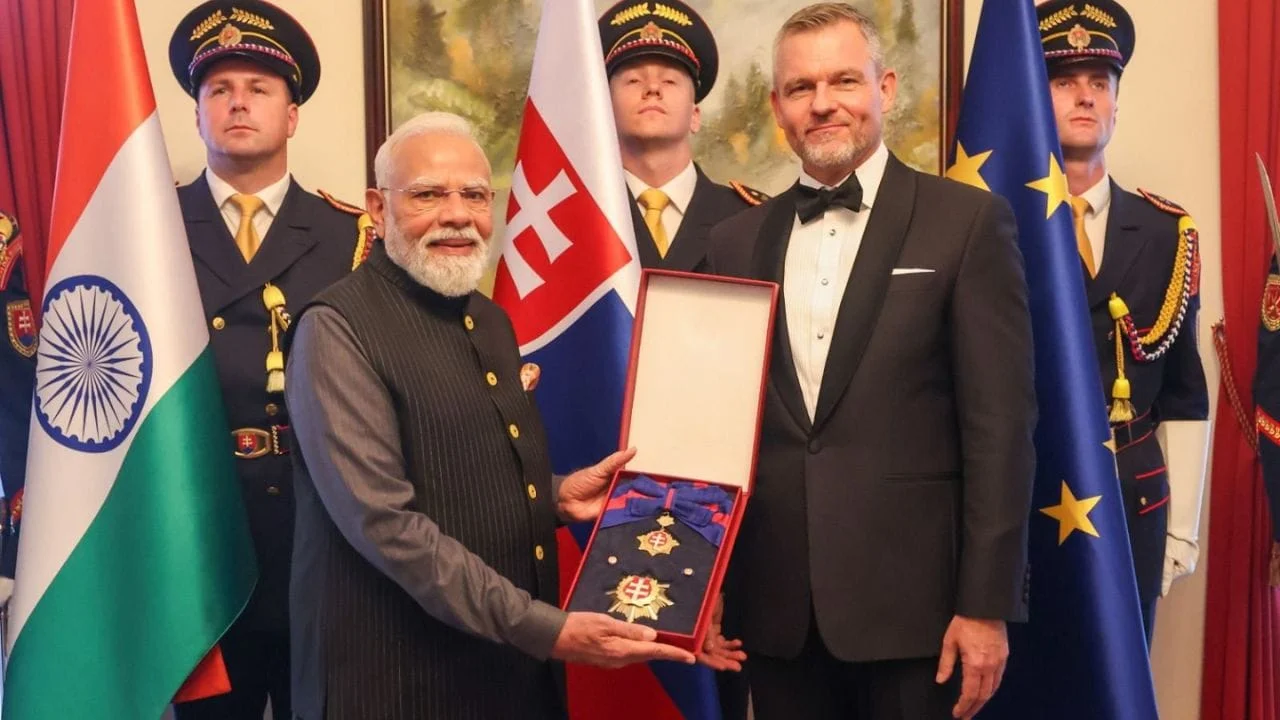
Prime Minister Narendra Modi has been conferred with Slovakia's highest civilian decoration, the Order of the White Double Cross (First Class), during his official visit to the Central European nation. The prestigious award was presented by Slovak President Peter Pellegrini at the Presidential Palace in Bratislava, marking a significant milestone in India-Slovakia bilateral relations. This recognition represents the 33rd international honour bestowed upon Modi by foreign nations, reflecting India's growing diplomatic engagement and rising global stature.
The Prime Minister accepted the award with heartfelt gratitude, stating that the recognition belongs not to him alone but to the 1.4 billion people of India. He dedicated the honour to the enduring and strong friendship between India and Slovakia, hoping it would inspire future generations in both countries to continue nurturing their special relationship. The Order of the White Double Cross is Slovakia's highest state decoration, typically conferred upon foreign dignitaries for exceptional contributions to strengthening international relations and advancing bilateral cooperation.
Modi's visit to Slovakia carries profound historical significance, as it marks the first time an Indian Prime Minister has travelled to the country since its independence in 1993. Upon arrival in Bratislava, the Prime Minister received a ceremonial welcome that included a traditional Slovak greeting involving the offering of bread and salt. This centuries-old Slavic ritual symbolises hospitality, abundance, friendship, and trust, with the guest breaking off a piece of fresh bread and dipping it in salt before eating.
The Prime Minister was accompanied by a high-level delegation including External Affairs Minister S. Jaishankar, National Security Advisor Ajit Doval, and Foreign Secretary Vikram Misri. The visit follows President Droupadi Murmu's state visit to Slovakia in April 2025 and Slovak President Peter Pellegrini's visit to India for the AI Impact Summit in February 2026. These recent high-level exchanges demonstrate the significantly growing diplomatic communication between the two nations.
During his two-day official visit, Prime Minister Modi held extensive discussions with Slovak Prime Minister Robert Fico at Bratislava Castle, covering multiple areas of mutual interest. The leaders explored opportunities for expanding cooperation in trade, investment, technology, defence, innovation, automobile manufacturing, railway development, healthcare, and clean energy. Both sides underscored the importance of boosting business partnerships, technological collaboration, and people-to-people exchanges while encouraging greater investment flows and joint ventures.
The discussions resulted in the elevation of bilateral relations to the status of a Comprehensive Partnership, reflecting the shared trust and priorities of both countries. Following the talks, India and Slovakia signed 11 agreements and memoranda of understanding covering diverse sectors including defence cooperation, labour migration, digital technologies, quantum communication, cyber-security, and higher education. A Letter of Intent on defence cooperation was also finalised, which will give new momentum to joint development, joint production, and collaboration between defence industries of both sides.
Prime Minister Modi emphasised the potential for deeper cooperation with Slovakia in fields such as automobiles, railways, space, advanced manufacturing, and artificial intelligence. He noted that Slovakia's first satellite was launched by India in 2017, highlighting the existing capabilities in space cooperation. Civil nuclear energy was identified as a priority area, with both leaders emphasising the need to enhance cooperation between industry experts and professionals in this sector.
The two sides welcomed the conclusion of negotiations on the India-European Union Free Trade Agreement, described as one of the most ambitious trade pacts ever signed. Modi expressed special gratitude for Slovakia's support in finalising this agreement and conveyed his commitment to working towards its early implementation. This trade deal is expected to significantly shore up bilateral economic engagement and benefit industries, startups, and businesses in both countries.
An important agreement on labour migration was concluded to facilitate the orderly, safe, and legal mobility of skilled professionals between India and Slovakia. Both sides also agreed to work towards the early conclusion of a Social Security Agreement, which would contribute to safeguarding the welfare and social protection of working professionals engaged in mobility between the two countries. This demonstrates a shared commitment to protecting the interests of their citizens working abroad.
Prime Minister Fico expressed support for India's position on key global issues, including the reform of the United Nations and India's inclusion in an expanded Security Council as a permanent member. Both leaders backed concerted global efforts to combat terrorism in a sustained manner and called for strong, decisive action against terrorist entities, their proxies, sponsors, and supporters. They emphasised the importance of holding perpetrators, organisers, and sponsors of terrorist acts accountable.
Recognising the growing geopolitical, economic, and technological importance of the Indo-Pacific region, both leaders acknowledged the value of a stronger partnership between India and Slovakia. This partnership aims to support mutually beneficial cooperation, regional connectivity, open international trade, freedom of navigation, and the peaceful resolution of disputes. The joint statement issued after the talks reflected the convergence of interests between the two nations on multiple fronts.
The Prime Minister also participated in a special yoga session organised at the Presidential Palace to mark International Yoga Day, alongside President Pellegrini. He later toured a special exhibition inspired by Varanasi, showcasing the rich cultural heritage of India. These cultural engagements highlighted the importance of soft power and people-to-people connections in strengthening bilateral ties.
Modi's visit to Slovakia is being viewed as an important step in India's outreach to Central Europe, demonstrating the country's commitment to deepening engagement with the region. The comprehensive partnership established during this visit is expected to open new avenues for cooperation across multiple sectors, benefiting both nations. Officials described the recognition and the strengthened ties as a testament to the strong and enduring friendship between India and Slovakia.