

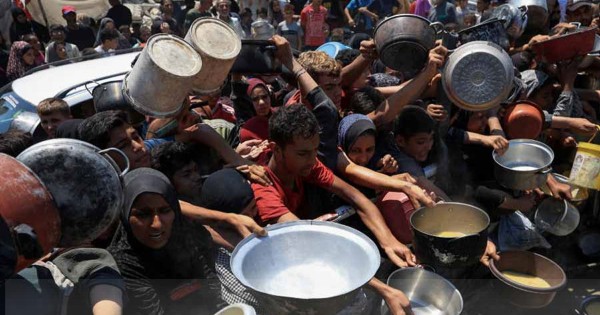
The humanitarian crisis in Gaza is worsening rapidly. Hunger, thirst, and lack of resources are now affecting even medical workers. Many doctors and nurses are collapsing from exhaustion and malnutrition while trying to care for patients.
Israel recently lifted restrictions on aid delivery to Gaza. Following this, several countries began air-dropping food and supplies into the region. The United Arab Emirates and Jordan have already dropped 25 tons of relief goods by parachute.
However, even with international aid efforts, fear and uncertainty remain. Food shortages continue across Gaza. Hospitals still operating are struggling to provide care. Some nurses have fainted while on duty due to extreme hunger and dehydration.
Hospital officials say they are unable to supply food regularly to both patients and staff. Newborn babies are especially vulnerable. In some hospitals, babies are being given only water because there is no formula or milk available.
According to the New York Times, seven doctors working in Gaza confirmed the critical situation. Four of them are Gaza residents, while the other three came from Australia, the United Kingdom, and the United States to help with emergency medical services.
They reported that the ongoing Israeli airstrikes over recent months have caused severe disruptions to food distribution. The local Health Ministry in Gaza stated that at least 56 Palestinians have died from starvation just this month.
The food crisis is becoming more desperate each day. Medical workers are also beginning to suffer from malnutrition. Some are reporting dizziness and weakness. Many have collapsed in hospital wards and needed glucose or saline to recover.
Although food is still available in limited stores across some areas in Gaza, the prices are far beyond what most people can afford. A kilogram of flour or tomatoes is reportedly being sold for as much as $30 (over ₹2,500 in Indian currency).
Basic staples like rice or meat are nearly impossible to find in the open market. This leaves ordinary people in Gaza with two harsh choices: either risk dying of hunger or risk their lives going to aid distribution centers.
There have been repeated reports of civilians being killed on their way to aid camps by Israeli military strikes. These incidents have intensified global criticism of Israel's handling of the crisis.
Under increasing pressure from the international community, Israel has now started its own aid drops into Gaza. On Saturday, the Israeli Defense Forces (IDF) confirmed that they air-dropped sacks of flour, sugar, and canned food.
However, humanitarian groups argue that these amounts are far from enough. According to some sources, a single truck could carry more food than all of the air-dropped supplies combined. The scale of the crisis demands far larger deliveries.
In an effort to support aid delivery, Israel has declared a daily pause in military operations in three areas of Gaza. These include Al-Mawasi, Deir al-Balah, and Gaza City. The pause will be in effect from 10 a.m. to 8 p.m. each day.
Additionally, some roads in Gaza will remain open from 6 a.m. to 11 p.m. to allow humanitarian aid to move more freely. Israeli officials say these measures are intended to assist ongoing relief work in the war-torn region.
Despite these announcements, many people remain skeptical. The memory of recent attacks on civilians headed to aid centers continues to raise doubts about whether these corridors will be truly safe or effective.
Meanwhile, other countries continue their efforts to send help. The UAE and Jordan recently delivered 25 tons of food and medical supplies using parachutes. More such drops are expected in the coming days, but it is still unclear if they will meet the growing needs.
The aid coming into Gaza faces multiple challenges. The volume may not be enough, and access to aid can still be dangerous for those in need. Many are afraid to approach distribution sites due to past attacks.
People across Gaza are losing hope as their hunger worsens. Medical professionals — already exhausted from months of treating war casualties — are now facing physical collapse themselves. With no clear end in sight, the situation continues to spiral downward.
This ongoing humanitarian disaster is pushing Gaza to the brink. Without consistent, safe, and large-scale aid, the region risks seeing even more deaths from starvation and untreated illness.
The international community is urging stronger and faster action to prevent further suffering. Many believe that immediate and unhindered access to aid is essential for saving lives and stabilizing the region.
For the people of Gaza, each day is a struggle for survival — not just from bombs, but from hunger, thirst, and fear. The world is watching, but action may not be coming fast enough.