

In Gaza, the humanitarian situation has reached a breaking point. Shocking images of starving children and helpless mothers with empty bowls are flooding social media. Hunger has already claimed 124 lives, including 81 children, as the crisis worsens each day.
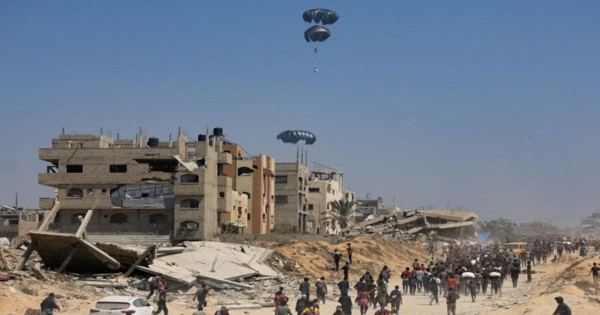
As criticism mounts globally over Israel’s handling of the Gaza situation, the country has taken its first visible step to respond. For the first time, Israel has air-dropped food and essential supplies directly into Gaza’s territory.
The Israeli Defense Forces confirmed that aid was dropped on Sunday. The relief packages included flour, sugar, medicines, and packaged food. This initiative was carried out in partnership with international aid organizations to ease the food shortage in the war-torn region.
Since March, Israel had imposed a blockade on Gaza, restricting the entry of aid and basic supplies. That blockade has now been partially lifted. In addition, Israel has declared a ceasefire in three key areas of Gaza to facilitate the delivery of humanitarian aid.
According to Israeli officials, they will no longer obstruct international aid efforts meant for Gaza’s civilians. They stated that air support and logistical help will be provided to ensure food reaches those in need.
Israel also announced that other countries wishing to send humanitarian supplies to Gaza will not face any obstacles. This statement comes after widespread condemnation of Israel’s actions and its alleged use of hunger as a weapon of war.
For the past 22 months, Gaza has been caught in an intense and uneven conflict between Hamas and Israel. While military operations continue, it is the civilians who are suffering the most. Over 60,000 people have reportedly died, and more than 150,000 have been injured due to Israeli airstrikes.
However, the growing food crisis may be even more alarming than the death toll. Hunger is now one of the leading causes of death in Gaza. Reports indicate that 24 people, most of them children, have died of starvation in recent months.
In July alone, at least 40 people died from hunger, including 16 children. The worsening food shortage means that even accessing aid camps has become a matter of life and death. There are reports of Israeli forces firing on people trying to collect food.
The United Nations has released a report describing the dire conditions in Gaza. Since May, more than 1,000 people have died while trying to reach aid distribution centers. Food scarcity has reached its peak, and over 2 million people now lack access to basic nutrition.
Gaza’s residents are surviving on minimal supplies, and aid centers are their only hope. But even there, they are not safe. Hunger-stricken civilians standing in food lines have reportedly been shot at by Israeli soldiers, adding to the chaos and fear.
UN Secretary-General António Guterres has described the situation in Gaza as one of the worst humanitarian disasters in recent history. He said Gaza has reached a level of death and destruction unlike anything seen before.
Human rights organizations have accused Israel of deliberately using starvation as a weapon to wipe Gaza off the map. These allegations have drawn strong reactions from around the world, forcing Israel to reconsider its approach.
Under mounting pressure, Israel has started to step back from its previous hardline stance on blocking aid. To avoid further international criticism, the Israeli government has now allowed the first round of air-dropped food aid into Gaza.
Despite this development, questions remain about whether this aid will be enough to address the crisis. Humanitarian groups argue that a few air-drops are not sufficient. What is needed is continuous and unrestricted access to food and medical supplies.
Aid agencies are calling for a full humanitarian corridor to be opened, allowing trucks and medical teams to reach Gaza safely. They insist that air-dropping food cannot replace the need for regular and large-scale deliveries by land.
Civilians in Gaza are still waiting for sustained help. While the initial aid drop brings a glimmer of hope, the overall need is far greater. Hunger and malnutrition continue to rise, especially among children and the elderly.
To truly solve the crisis, experts say there must be an immediate and lasting ceasefire, removal of all blockades, and global cooperation to rebuild Gaza’s destroyed infrastructure. Until then, millions remain trapped in a daily struggle for survival.