
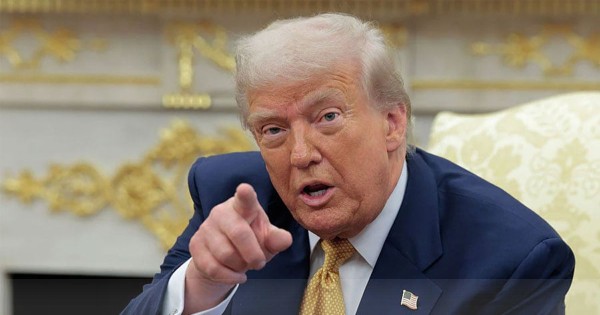
Donald Trump has stepped into the ongoing conflict between Cambodia and Thailand, offering himself once again as a “messenger of peace” — this time with trade as his main tool. As tensions rise over a disputed temple area, Trump has made it clear: the United States will not engage in trade with either country until they agree to a full ceasefire.
Fighting broke out between the two Southeast Asian countries over a Hindu temple located near their shared border. The conflict has already claimed the lives of 33 people. In response, Trump made phone calls to the leaders of both nations and issued a strong message.
Speaking from Scotland, where he is currently visiting, Trump said he spoke directly with the Prime Minister of Cambodia. He also contacted Thailand’s Prime Minister to share Cambodia’s interest in ending the conflict. He later posted about these conversations on social media.
In one post, Trump said, “I spoke to Cambodia’s Prime Minister to stop the war with Thailand.” In another, he added, “I’ve also spoken to Thailand’s Prime Minister to share Cambodia’s request for a ceasefire. Thailand also wants immediate peace. I will now inform Cambodia of Thailand’s response.”
Trump expressed optimism that peace talks could lead to long-term stability in the region. He said both countries are interested in maintaining trade relations with the United States. However, until the fighting ends completely, there will be no trade agreements from the U.S.
He made it clear that the U.S. will only resume trade after full peace is restored. Trump said, “Once both nations walk the path of peace, we will negotiate trade deals. But until then, all business is on hold.”
The conflict began early Thursday morning with heavy gunfire exchanged between the armies of Cambodia and Thailand. The fighting has caused major bloodshed and panic in the region. Cambodian officials formally asked Thailand to stop military action on Saturday.
So far, Thailand has not responded to Cambodia’s request to end the fighting. The core issue behind the war is a temple known as the Preah Vihear Temple, located in the “Emerald Triangle” near the border. Both Cambodia and Thailand claim ownership of the temple and surrounding areas.
This sacred site holds emotional and cultural significance for people in both countries. The same area triggered a deadly battle between the two nations nearly 15 years ago. Now, history appears to be repeating itself with renewed violence over the same land.
On Thursday morning, fighting escalated sharply when Thai fighter jets crossed into Cambodian territory and launched airstrikes. The military confrontation marked one of the most intense moments in the region in recent years.
Trump’s move to intervene follows a familiar pattern. He has previously tried to position himself as a peace broker in international conflicts. In the past, he spoke out about hostilities between Israel and Iran, as well as violence between Congo and Rwanda.
He also expressed interest in calming tensions between India and Pakistan. However, India rejected any suggestion that outside mediation was needed, insisting the matter was internal and bilateral.
Analysts believe Trump’s actions may also be driven by his desire to be seen as a global peace leader. With eyes on a potential Nobel Peace Prize, Trump is once again trying to showcase his diplomatic influence on the world stage.
Using economic pressure instead of military force, Trump is pushing Cambodia and Thailand to reach a peaceful solution. He believes trade holds more power than weapons when it comes to influencing political decisions and preventing war.
His trade-first approach signals a new kind of diplomacy — one where business deals are directly tied to peace and stability. While critics may question his motives, the message is clear: the United States will not support or trade with nations that choose war over negotiation.
This approach could set a precedent for how future conflicts are addressed. By linking peace to economic benefits, Trump is encouraging countries to consider the financial cost of war. In a globalized economy, losing access to trade with the U.S. can have serious consequences.
It remains to be seen whether Cambodia and Thailand will respond positively to Trump’s warning. If they choose to end the conflict and return to peaceful talks, it could lead to stronger economic and diplomatic ties with the U.S. in the future.
For now, the region waits. The violence continues, but with growing international pressure and Trump’s economic threat, there is hope that both countries will step back from the brink of war and move toward dialogue.
Trump’s involvement may not guarantee peace, but it puts a global spotlight on the issue. With lives already lost and no clear winner in sight, peace remains the only sustainable option for both Cambodia and Thailand.