

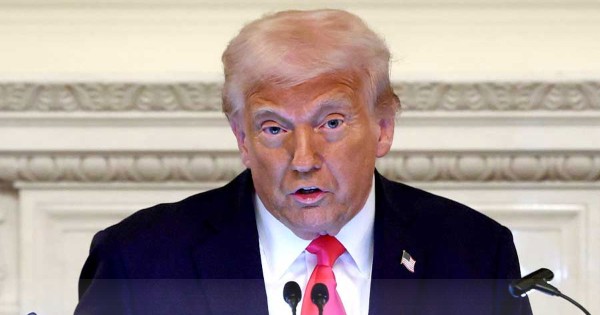
U.S. President Donald Trump has announced that both Cambodia and Thailand have agreed to a ceasefire after several days of deadly conflict. Trump shared the update in a post on his social media platform, Truth Social.
Trump claimed that he spoke with Cambodian Prime Minister Hun Manet and Thai Prime Minister Phumtham Wechayachai. According to him, both leaders assured him they are ready for an immediate ceasefire and want to restore peace.
In his post, Trump wrote that the talks were productive. He said Cambodia was informed about discussions held earlier with Thailand. Both countries expressed interest in ending the violence and returning to peaceful negotiations.
Trump mentioned that the leaders are also open to resuming trade discussions with the United States. However, he said no trade would be possible unless the fighting completely stops and stability returns to the region.
He added that both countries agreed to meet soon and are committed to achieving peace. Trump said he was honored to speak with the leaders and highlighted the rich cultural and historical heritage shared by the two nations.
He concluded by saying that if the peace process succeeds, the U.S. would be ready to rebuild trade relations with Cambodia and Thailand. Trump positioned himself once again as a peacemaker on the global stage.
Trump had previously indicated, while visiting Scotland, that he was trying to help stop the conflict between the two countries. He used his social media platform to update his followers on the situation and his involvement.
The conflict began early Thursday morning with heavy fighting along the Cambodia-Thailand border. Intense shelling continued for three days, causing severe damage and loss of life in the disputed area.
Cambodia formally asked Thailand to stop the attacks on Saturday. However, at first, Thailand did not respond to Cambodia’s request for a ceasefire. This made the situation even more tense.
The root of the conflict lies in a long-standing territorial dispute over a Hindu temple located in the “Emerald Triangle” near the border. Both Cambodia and Thailand claim ownership of the temple and surrounding land.
The temple, believed to be centuries old, holds deep cultural and religious importance for the people of both countries. The surrounding area is not just a religious site but also a symbol of national pride.
This is not the first time the temple has caused conflict. About fifteen years ago, Cambodia and Thailand fought another violent battle over control of the same region, which also led to many casualties.
In the latest round of fighting, both armies exchanged gunfire in the early hours of Thursday. Soon after, Thai fighter jets reportedly entered Cambodian airspace and launched strikes, escalating the violence further.
The military operations left dozens injured and killed at least 33 people from both sides. Villages near the border were also affected, with residents fleeing to safer areas to avoid getting caught in the crossfire.
International observers raised concerns over the rapid escalation and called for both sides to respect international borders and avoid further bloodshed. Regional leaders also pushed for urgent diplomatic intervention.
Trump’s latest post included not only his comments on Cambodia and Thailand but also a mention of India and Pakistan. He compared the Southeast Asian crisis to the long-standing tensions between the two South Asian nations.
While he did not go into detail, Trump hinted that peace talks and economic pressure could be tools in easing tensions in other regions as well. His mention of India and Pakistan suggested he sees parallels in other global disputes.
Although Trump is no longer president, he continues to use his platform to voice opinions on international matters. His involvement in the Cambodia-Thailand conflict is being closely watched by political analysts.
Some view his actions as an attempt to remain relevant in international affairs and position himself as a leader who values peace over war. Others believe the focus on trade highlights his preference for economic diplomacy.
Trump has made similar moves in the past, offering to mediate conflicts in the Middle East, Africa, and South Asia. His suggestion to help resolve the Kashmir issue between India and Pakistan was rejected by India at the time.
Still, Trump continues to present himself as a global peace advocate. By linking trade and diplomacy, he believes the U.S. can encourage nations to resolve conflicts without violence.
If the ceasefire between Cambodia and Thailand holds, it could be seen as a diplomatic success. However, many experts say the deep-rooted issues between the two countries will need long-term solutions beyond temporary truces.
For now, both Cambodia and Thailand appear to be stepping back from the edge of war. The hope is that further violence can be avoided and lasting peace can be achieved through dialogue and mutual respect.
The coming days will reveal whether the ceasefire agreement leads to real progress. Regional cooperation, international support, and steady diplomacy will be key to preventing future conflicts.