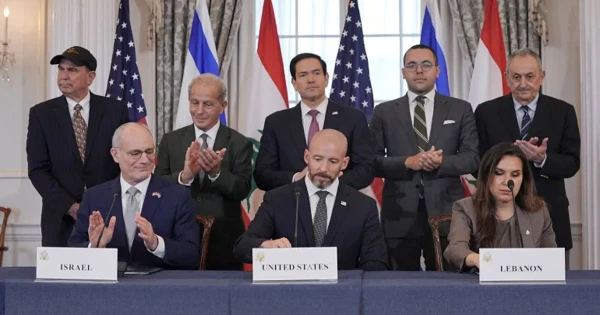
Lebanon has effectively signed a declaration of intent with Israel after months of fighting, diplomatic pressure, and last-minute maneuvering in Washington. The backlash arrived almost immediately, with Hezbollah and its political allies denouncing the deal as a surrender and demonstrators taking to the streets of Beirut.
The framework agreement was signed on June 26, 2026, at the State Department in Washington, D.C. Representatives of Israel, Lebanon, and the United States put their names to a document meant to end months of open warfare between Israel and the Iran-backed militant group Hezbollah. Fighting had resumed on March 2, 2026, and Israeli strikes have since killed more than 4,000 people in Lebanon, according to Lebanese officials, while displacing over a million residents, more than a fifth of the country's population.
On paper, the agreement lays out what negotiators call a sequenced process. The Lebanese army is meant to restore full sovereign authority over Lebanese territory, but only once non-state armed groups, a clear reference to Hezbollah, have been verifiably disarmed. Only after that happens is Israel expected to begin a gradual withdrawal. Two initial pilot zones have been designated for an early Israeli pullback, with the Lebanese military expected to assume security responsibility there once disarmament in those areas is confirmed by a third party.

Critics say this sequencing is the document's central flaw. Rather than requiring Israel to withdraw first and Hezbollah to disarm afterward, the agreement makes Israeli withdrawal conditional on Hezbollah first giving up its weapons, something the group has repeatedly and publicly refused to do. Hezbollah was not a party to the negotiations and was not present at the table when the framework was drafted.
Hezbollah's Secretary-General, Naim Qassem, condemned the agreement within days of the signing, calling it humiliating and describing it as a surrender of Lebanese sovereignty. He argued that tying any Israeli withdrawal to his group's disarmament crossed what he called a red line, and he insisted Hezbollah would neither lay down its weapons nor stop fighting Israeli forces. A Hezbollah lawmaker went further, warning that any attempt by the Lebanese army to forcibly implement the agreement's terms could push the country toward civil war.
This is not the first time Hezbollah's disarmament has been placed at the center of a diplomatic deal. A previous ceasefire reached in November 2024 also called for the group to give up its weapons, but implementation collapsed as Israel continued near-daily strikes into Lebanon and declined to fully withdraw its own forces, according to reporting from the region. Lebanese officials have since acknowledged they were reluctant to confront Hezbollah directly, fearing that doing so could ignite internal conflict.
Comparisons to past Middle East diplomacy are difficult to avoid. The Oslo Accords of the 1990s were formally titled a Declaration of Principles and offered only general guidelines for negotiations that were supposed to follow. Contentious issues including borders, settlements, the status of Jerusalem, and the fate of refugees were deliberately left for a later stage that, in practice, never fully arrived. Critics of the new Lebanon framework argue that the interim arrangement in that earlier case became a permanent condition, one that allowed Israel considerable latitude while Palestinians were held to standards they had little practical ability to meet.
Lebanon is not Palestine, and the current circumstances differ in important ways. But the diplomatic architecture bears an uncomfortable resemblance: two parties declare an intention to end conflict while leaving the hardest questions unresolved. What looks like flexibility on paper can function, in practice, as a trap that leaves one side absorbing most of the risk.
Analysts point to structural reasons why the framework will be difficult to carry out as written. The Lebanese state has no realistic mechanism to simply dissolve Hezbollah by decree. The group's arsenal is not just a military asset; it is bound up with a political narrative about resistance, protecting Shia communities, and compensating for what supporters see as the Lebanese state's historic failure to defend its own territory. That structure cannot be dismantled by a document signed in Washington.
The Lebanese Armed Forces, meanwhile, face real constraints. The military remains underfunded, stretched thin, and dependent on outside assistance that is itself shaped by red lines set in Washington and Jerusalem. Asking Lebanon's army to suddenly function as a fully sovereign deterrent force, capable of disarming a better-equipped and battle-hardened militia, sets an extraordinarily high bar for an institution that has struggled for years with basic funding.
In effect, the deal asks Lebanon to behave like a fully sovereign state precisely in the areas where its sovereignty is weakest. It is expected to rein in an armed group it cannot militarily defeat, negotiate credibly with a far stronger adversary it cannot deter, and accept binding obligations whose success depends heavily on outside powers that do not always prioritize Lebanese sovereignty.
Because Lebanon cannot match Israel militarily, some observers argue that diplomatic, legal, and political tools are the country's last remaining forms of leverage. If the new framework also narrows those options, for instance by limiting Lebanon's ability to pursue legal action through international courts in the name of reducing tensions, critics say the country is being disarmed in the very arenas where it retained some influence.
There is also a constitutional dimension complicating matters. Facing intense domestic criticism, Lebanon's president and prime minister may be inclined to describe the document as a political understanding rather than a binding treaty. But legal analysts note that relabeling an agreement does not change its substance. If it addresses war, peace, territory, international obligations, security arrangements, recognition, or legal constraints, it functions as more than an informal diplomatic memo regardless of what it is called.
Lebanon's constitution does not grant any single official the authority to make such sweeping commitments unilaterally. International agreements typically require formal institutional approval, and decisions touching on matters of war and peace fall under the authority of the full cabinet, with multiple layers of consent required for major commitments. If a declaration of intent is used to impose treaty-like obligations without following that process, critics argue it effectively bypasses the constitutional safeguards meant to protect Lebanese sovereignty. The constitution also requires the state to preserve its territorial integrity, meaning any declaration that quietly normalizes an Israeli security presence, or makes Lebanese sovereignty contingent on Israel's own assessment of Hezbollah's disarmament, sits on uncertain legal ground.
This is where the agreement becomes especially combustible politically. Hezbollah, the allied Amal Movement, and other opposition figures have multiple avenues to stall implementation. They can insist that the deal requires full cabinet approval before taking effect. They can question whether elements of the agreement amount to normalization of relations with Israel. They can demand a clearer timetable for Israeli withdrawal. They can resist any language that limits Lebanon's right to pursue legal action against Israel internationally. Taken together, these objections could tie the agreement up in committee reviews, constitutional disputes, and prolonged procedural delays.
Public opinion inside Lebanon appears sharply divided along sectarian lines. A survey conducted in the spring of 2026 by a regional polling organization, drawing on roughly 2,000 respondents across different religious communities, found broad differences in attitudes toward a peace deal with Israel. Support was highest among Druze, Maronite Christian, and Orthodox Christian respondents, while a large majority of Shiite respondents, the community from which Hezbollah draws most of its support, opposed such an agreement. On the specific question of disarming Hezbollah, support was strongest among Christian and Druze communities and weakest among Shiite and Sunni respondents.
Israeli officials, for their part, have sent mixed signals about their own commitment to withdrawal. Israeli Prime Minister Benjamin Netanyahu has said Israeli forces will remain in southern Lebanon until Hezbollah and other armed groups are disarmed and until no further threat is posed to Israel from Lebanese territory. Israel's defense minister has instructed the military to prepare for an extended presence in the country. Some Israeli cabinet members have suggested Israel may maintain a long-term footprint in Lebanon regardless of how disarmament unfolds, even though the framework itself states Israel has no territorial ambitions inside Lebanon.
Much of what happens next may ultimately be determined outside Lebanon entirely. The broader regional context, including the trajectory of talks between the United States and Iran, could shape whether Hezbollah is willing to quietly accept the framework over time or resist it more actively. If wider regional tensions ease and hold, Hezbollah may choose to absorb the agreement without open confrontation. If that broader picture deteriorates, the framework's carefully worded language is unlikely to restrain fighting on the ground.
For now, Lebanon's government appears to be betting on time. By signing the agreement and describing it in terms that leave room for future renegotiation, Lebanese leaders may be hoping that the passage of time, shifting regional dynamics, or changes in Washington's priorities will eventually soften the deal's harder edges. Whether that bet pays off, or instead leaves Lebanon shouldering blame for a conflict it has limited ability to control, remains one of the central uncertainties hanging over the fragile peace process.